Wednesday, 4 April 2012

Understanding Paddy, finally


(Note to mom and dad: yes i'm walking barefoot in a paddy field, but endemic schistosomiasis in Indonesia is limited to Sulawesi.)

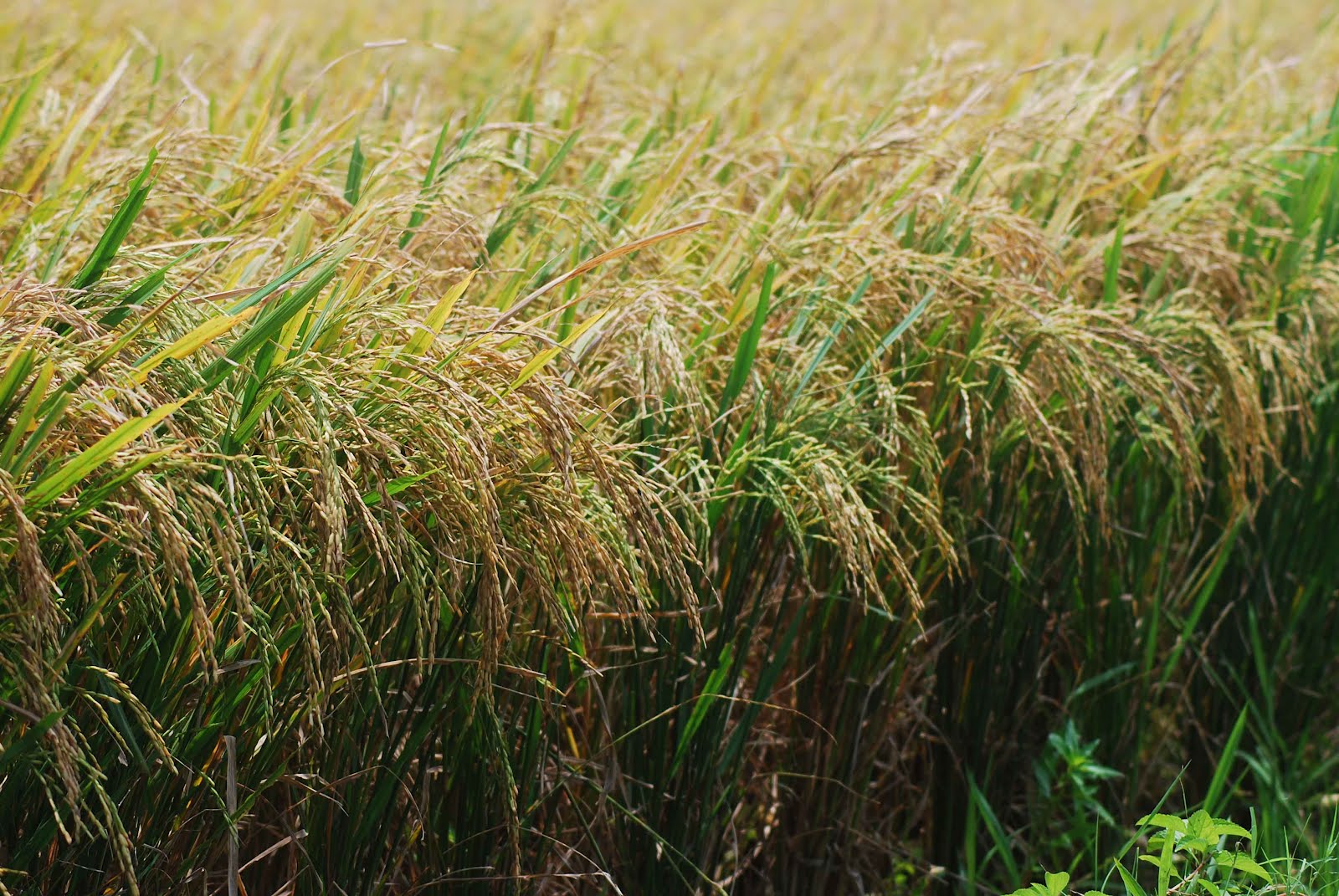
As an agri-economist, I've always regarded paddy cultivation as one of my areas of relative ignorance. If there was one thing I knew too little about which feeds millions of people worldwide, it was rice: rice growing, rice transplanting, rice cultivation in lowlands (in continuously puddled fields) vis-a-vis rice cultivation in highlands (dry areas and only rainfed), rice harvest, post-harvest handling such as threshing, rice dehusking etc.

I still know very little. But since last month I feel like I know a little something. At least.

IRRI, the International Rice Research Institute, has these nice learning modules on rice and soil fertility on their website and a final online quiz. And so I tested myself and found that I aced the quiz.

Paddy cultivation is very special and distinct from other forms of agriculture. One of the most interesting things to learn was that under anaerobic conditions, in puddled fields, the sort of electro-chemical processes in the soil are not at all the same as under aerobic conditions. The nitrogen cycle, for example, is quite different. Wheras under normal (aerobic) conditions, urea fertilizer is typically lost through leeching or nitrification, under anaerobic condition it is more probably lost through volatilization (gaseous loss).


Following this preparation, I thought I was ready for a workshop with rice farmers on soil fertility and soil testing. That's what we did on a very windy day in Lombok. Walking through puddled rice fields, making holes with an Auger borer and sampling soil.


And I was pleased with the result. Of course the farmers have all the practical experience and i have none. Everything I know and learned comes from studying and reading documents.
But I did feel like I knew very many things about rice soil fertility and about growing healthy rice plants that the farmers didn't. In fact, I knew so much (admittedly not all of it would have been practical for the farmers) and found there was so little time to explain it to them, that I didn't even get to deliver most of the stuff I knew...


But I'm excited about my work. When I was 25, after riding rickshaw for 1.5 years, I enrolled in an agricultural Masters program at Uni. I've never looked back since.
Working with farmers in developing countries is fascinating and I'm happy to have found what I want to do, finally, at the age of 29. (That's not so bad considering my dad is still figuring out at 68 if he should have become a carpenter! I would have liked that... or for him to be a gardener.... instead he became a white-collar worker, aarrgh!).


I know I will take a break from time to time from this, because not everything about development work is great; and also to enjoy the luxuries of living in an industrialized country or to see my sister start her own little family.

But this thing here is my calling and it is my safest bet for ever becoming a fulfilled and happy young professional.

Saturday, 10 March 2012

The bug just gets into you...


That's how the surf legend Gerry Lopez describes it. He means regular surfing, which i'm not really into, but it's close enough. Windsurfing is my surfing.

In all fairness, this can happen to you with any other sport too. I'm currently reading Nick Hornby's "Fever pitch" in which he confesses about his obssession with football since childhood. His condition is far worse than mine. I'm not obssessed, just hooked (...almost a pun there).

Lombok is famous as a surfing destination, so naturally that's what every one does down in Kuta. I've seen a few kitesurfers too. Nobody does windsurfing here, and globally speaking, the sport has probably been in decline since 20 years. Only the die-hard windsurfers are still at it. Nowadays most people will take up kiting if they're gonna do a wind-water related activity, much in the same way that in winter sports most young people took up snowboarding (instead of skiing) once it had been invented.


On windsurfing, one of my friends here noted that it "consists of slightly nudging a sail back and forth". I don't think he has seen the aerials of Jason Polakow and the likes. Most other people here don't really know what windsurfing is.

Anyways, it's still cooler than swimming. I used to be a swimmer before. That was obviously very uncool. I wore speedos, goggles and a yellow swimming cap. As a windsurfer I'm now officially cool. All kinds of people in Kuta wanna talk to and associate with me suddenly. It's a superficial world!


This was posted by somebody on the iwindsurf community forum. So true!
(click on it for a close-up view) http://www.iwindsurf.com/forums/viewtopic.php?t=24020&postdays=0&postorder=asc&start=0&sid=12f059676552b9533bc67febb82fbee9

The wind has been poor in Lombok for a few weeks now and I've really begun to feel the sailor's doldrums. It is taxing. It is. It's like I'm a changed person now, I'm addicted, it's the bug that's really got me. I check the wind/weather forecast practically every day now just willing it to give me signs of reprieve: a day or two maybe. I wanna go windsurfing badly. Instead I just get to read weather reports online, analyze patterns, tables and graphs. Yeahie, fun!

A few months ago I also noticed that I had started greeting my neighbor with a Shaka sign. I shouldn't have done that; I'm really still a beginner and I reckon Shakas should be reserved for the veterans of the sport or at least advanced riders.

I've been sick for a few weeks including over Chinese New Year when there were a few windy days here in Lombok which I then had to miss on account of a bad catalpult in which I busted and badly bruised my left arm. And then I got fever. And something else threw my rhythm in-between that. But I'm back dancing again. Figuratively. The absence of wind didn't help to lift my spirits of course. But I went running down in Kuta a few times over the last two weeks and I've felt better health-wise. I'm still absolutely thrilled to live and work in Lombok. And I still would maintain it's a good place for windsurfing. But obviously it doesn't get as windy as Hawaii. So it's not really a "sustainable" outdoors activity to do here, in the sense that you can't really count on being able to do it every weekend. Which means I will never become as good as Mr Robby Naish.

If you don't like surfing there are other things to do in Kuta.
This is what we came up with. It's called the "Great ball bouncing game". The rules are like the medieval knights' jousting battles, but instead of charging each other with lances and on horse-back we do it on foot and with great bouncing balls.

I also met an American, Larry, who's been living down in Kuta for years and he is a veteran windsurfer, and real fun! How cool is that!! He must have thought he was the last unicorn until I came along. We talk about gear, the marvels of windsurfing, the good and bad sessions out on the water, the con's and pro's of kiting, and everything else related to windsurfing every time we see each other. It feels good to have a fellow windsurfer around.

It looks like it's my last few months here as my contract ends in September. Come June and July the tradewinds bring some nice northeasterlies. I can't wait for it. If this is my last season here, i'm gonna make it a good one.

Thursday, 19 January 2012

Lombok Traffic and more


NB: The pic above was taken by my friend Dewi in Bali, not in Lombok. It would be unwise to ride motorbike in Lombok wearing a bikini.
Bali traffic is kind of similar to that in Lombok, although I think I've found Balininese outside Bali-Kuta to be a little bit more patient and amicable in traffic.

A couple of years ago it was governorally decreed that motor-cyclists must switch on head-lights at all times of the day. Police at Praya's two traffic check-points now enforce this rule between 8:00 and 16:00 hours, as with helmets which are mandatory. But after 5 pm nobody gives a damn.

In rural areas, the majority of motor-cyclists still drive without helmets, let alone headlights. I do welcome mandatory helmet laws but more is needed to educate people about traffic rules and what's not safe driving: suddenly pulling into the opposite lane; driving in the middle of the road for no apparent reason; stopping abruptly. And what is the most disturbing to me of all: swerving recklessly around corners onto main roads. Everyone continues their haphazard ways in traffic, in spite of helmets and headlights rule.

I heard that every week some 500 new motorcycles are being registered on Lombok's streets. Not to mention the unregistered bikes. And no way can the provincial and local government add new roads at that rate. The pot-holes don't get better either. Some roads are repaired, others crack anew.


In a way this traffic behavior is congenial to drivers here. Everyone keeps moving forward. Or so they think. The argument is often made that there is order in chaos, or some form of efficiency. I wonder if that's true. It's not apparent to my eyes. I'd be interested to see a study on this.
I've seen Gordic knots in traffic here in Lombok. Traffic came to a complete halt. Motorcyclists pulling in from the rear of a traffic jam always fill every last gap at the spearhead of the traffic, where the jam occurs, making the node ever larger and harder to break.

Bad driving takes its toll on human lives here too. And often enough, it's the wrongdoing party injuring a diligent driver. This happened to a friend of mine. He was hit by speeding boys. He was lucky to survive. What is needed is traffic education.


Because in Europe and North-America one hundred years ago, motorized vehicles were introduced and only gradually replaced horse-drawn charriots, people had time to adjust. Coupled with a stronger tradition of law enforcement in the West, it worked out fine. But here, well it seems even twelve year olds seem to have the money or pull (with his parents) to own a motor-bike and ride it to school.

It's important to be empathetic as a driver here. And to understand that the rules are like... on a ski hill. Lombok traffic works a bit like traffic rules on ski hills: if you're coming from behind and from up on the slope then you heed who is in front of you and down-hill. No-one cares what's behind them, everyone just looks ahead. This can be evidenced by the scarcity of intact rear-mirrors on motorcycles. Only about 30% of motorcycles have both rear-mirrors, and only 30% of those who have them will use them. The percentage of conscientious and diligent drivers is wee small.

Still, I will give credit to motorcyclists and car driver about being understanding and forgiving in traffic situations. A near-death collision? The parties may just smile, shrug it off and drive on.

Perhaps they are too forgiving? In Germany, reactions by other drivers are an efficient educative mechanism to enforce traffic rule compliance. In other words: social control. In Berlin I have witnessed many cases of convulsive road-rage which would have merited no reaction at all by Lombok drivers. Let me expand on this point. For example, in Germany, it's an almost capital sin to slow down another driver for no reason, or especially force another to brake for you. A haphazard traffic maneuver will warrant a belligerent retributive honk, a Medusa stare, and not infrequently, a middle finger. I know what I'm talking about because I was a rickshaw driver there. I remember I sometimes blew a fuse myself.

At the same time, in Germany one is constantly on one's guard not to elicit such responses by other drivers. Because everyone goes to such great length to play by the rules, we are kind of offended if others don't. The social cohesion just breaks down. Here in Lombok, such is the aloofness of the perpetrator, it is not felt by him at all. And neither the affected parties or on-lookers will react with short-temper.

It is ironic that in Lombok, where communities are so governed by social control, this aspect of social control is not enforced at all. I think this is because traffic and transportation falls outside the realm of the “kampung” (neighbourhood) or “desa” (village). How else can youngsters get away with their reckless driving, including roaring motorcycle engines sounding at midnight down the street? The kampung's authority does not extend to the roads.

Tuesday, 3 January 2012

Windsurfing Lombok, at last!

This is my windsurf entry.

One day in Lombok, I thought to myself, I need something other than swimming to keep me happy in my free-time.


So I bought myself a windsurfer in November 2010. And began taking my first windsurfing steps after a loooong break from windsurfing. I was in way over my head. The board was too small, and too technical to ride, not to mention too fast. (Fanatic Falcon 111L). It's really a board meant for advanced riders. I love it now, but I didn't love it then. I'm sure the folks from the windsurf shop in Singapore meant well, little could they know about sailing conditions in Lombok and/or my skill level. (Although I do remember stating in the shop that I couldn't yet waterstart.) But when you have to learn planing on that kind of fickle board, or balancing on it to uphaul a 7m sail in rough conditions (because you don't know how to waterstart), it can be very unforgiving. And scary!


I knew so little about windsurfing, I had to consult Youtube on directions of how to rig up a sail properly.

In January 2011, my Naish 7.1m Rallye freerace sail (only sail!) and I took a little fateful tumble in the waves off Selong Blanak beach. It was a beautiful day, but hey I couldn't even make it past the shorebreak. The sail was practically torn into two under the weight of the crashing waves. No battens broke, surprisingly.

As I climbed out of the water and carried the rig out, my worst fears became true. I inspected the sail: it had a giant L-shaped gash that no amount of sailtape would ever fix.

I was only just learning how to balance myself on the board then... with broken equipment and no way to get a new sail quickly, my windsurfing was obviously going into hiatus. I was kind of in a state of shock and perplexity: did that just happen to me? Did that rogue wave - because that's what it was, a rogue wave - just kill my ambitions in a split second?

Learning to windsurf was what I've been waiting to do for a loooong time, I even had my motorcycle modified to be able to transport the board, sail and mast. I couldn't believe it. I dragged the torn sail behind me out of the water, you wouldn't believe it, but oh how mirthless a beautiful blue sky can be!

I don't have a photo to show for it, but the Naish Rallye looked in bad shape.

You know that feeling of happiness when it overcomes you and, say, you're on standing a beach... you suddenly find yourself doing cartwheels of joy? Well let me assure you, that was not a day to do cartwheels down the beach. I felt VERY mellow.


For the next 2 months, I wasn't up to much: mostly loafing around like a walrus, drinking beer, shooting cans. As Steven Wright noted: "24 beers in a case and 24 hours in a day....Coincidence?". I'm only joking. Saying stuff like that could probably get me fired. In March 2011 my parents brought me 2 new sails when visiting. It's stuff like that for which I'm super grateful to my parents for, even really indebted. Not stuff like edging me on to go to college (came out more confused), or making me learn more languages so that I could feel less rather than more polyglot ;) , or wearing braces (my teeth are crooked again).

I then broke another sail (Neilpryde 7.7m) on another beach, in another shorebreak. That was up in Senggigi. The wind had died, and I was sailing back to shore. And that's how that rogue wave caught up with me. And hit my board, and took me down.

No cartwheels of joy on that day either.


In August 2011 I met Hans and Henni Brunner from the Sanur Bali Windsurf Shop “Jump and Jibe”. They are great people, and super helpful and probably the only ones who are actively promoting windsurfing in Indonesia. Against prevailing wisdom, there is actually decent wind practically every month where I live in Indonesia, in Lombok. It's just a matter of driving to the right beach, and having the right 'informants' to tell you where it's a windy day. One of my best informants is Tambun, my preferred coconut seller on Tanju'an beach in Kuta, Lombok. His wind information (wind at planing threshold – yes or no?) is almost always spot-on. In return for this service, I buy copious amounts of coconuts from him.


I bought a 2-camber Freerace sail from Hans and Henni (Severne Turbo 8.6m) and a Lorch Breeze 142 L freeride board. They perform fairly neatly together. The sail is so light, I can waterstart it with relative ease, even at sub-planing conditions. At 10 knots, this equipment can get me planing, even as a passive rider. Yuppie! The upwind ability is okay too, and I'm still experimenting with different settings and one other fin. Of course against the bursting speed of the Fanatic Falcon the Lorch Breeze is more of a Sunday ride, with a lot less adrenaline kicks. But for me windsurfing is not really about going the fastest I can, it's more about hooking in, getting into the footstraps, planing away and taking in the scenery, the ocean, feeling the wind, the sun, and feeling a little bit Zen...

After those sessions, when windsurfing is just sheer joy, that's when I do cartwheels on the beach.

All pics were taken back in August. I don't have any more recent pics, but I hope soon!

Monday, 2 January 2012

Selamat Tahun Baru 2012 Everybody


Spent New Year's on Gilli T.
Gilli T was supposed to have the biggest party ANYWHERE in Lombok. It was not big. I didn't mind.
We strolled back and forth on a 200m stretch between a few bars and warungs, and then i called it a night for myself.
The best part was going to sleep in the wee hours of the morning, finally, on the beach. It drizzled slightly through the night and there was a songbird over my head, so i chanegd spots a few times in the night. The next morning, I woke up alone and found a rainbow over the ocean and Bali somwhere in the distance. A few other early birds on Gilli T were up and away strolling around the beach and we all greeted each other with friendly smiles. Indonesians are such kind people.

My highlights for 2011?
- First, my sis' wedding party, with alomst my whole family in attendance. My uncles and aunts stole the show a little bit, but that was to be expected (I think!?!). Still can't wait to see the dollar-bill-dance pics. Joerg looked so instantly smooth and shockingly at ease, it seems he must have practiced a lifetime for it. Who had the camera? Or was everyone just too enthralled in the dance to remember to catch the moment on film? I never quite knew family gatherings can be so much fun.
- Tobogganing in the Czech Republic with my Uni friends in early January 2011. A big WIHA!!!
- Learning to windsurf. I've had an appetite for windsurfing ever since my class did a summer school-trip from Bonn to Bodensee in 10th grade. I learned the basics then, but never learned how to use a harness or get into footstraps which are prerequisites for planing. I've waited 10 years since then and for the opportunity to take up windsurfing properly. In 2011 I am glad I finally got the chance. It's one of the greatest fun sports in the world. I now own 2 boards and 3 sails. My smaller board is a Falcon 2011 with 111 Liters and my other board is a Lorch 142L wood edition. The Falcon has a disgustingly fast acceleration. It goes from 0 to 40 km/h in a few seconds when the right gust hits you. The first times I experienced that holding on to the sail was literally all i could do. I came away from many of my early sessions with bruises and blisters, and generally still feel hopelessly clumsy and useless on the water, and very much desperate to finally nail a carve jibe. But, no, I'm not frustrated yet. 2012 will hopefully have more windsurfing in store and I'm absolutely stoked. Windsurf til ya drop! I'll post some more about this soon.

Those were my highlights.
Wish y'all the best, wherever you are and whatever you did. I won't be mad at you if you send me some parcels with chocolate, yerba maté or other goodies. What? No, nothing, just saying.

Sunday, 9 October 2011

Fancy Living in an Eco-Tourism Resort In the Jungle?


At the foot of the Rinjani National Park, in Lantan, Batukliang Utara, there lies an abandoned coffee processing site. It's a unique place, as it lies right in the jungle in a small dip of land. The ruins of the place which is said to have included the landlord's residence, a swimming-pool fed by natural spring water, some ponds for aquaculture, and who knows what other highlights, was destroyed following unrest and discord with the local population some 15 years ago.


The place is now overgrown with moss and plants. As you walk around you hear lizzards dart between the granite blocks. Adjacent to the site, spanning a couple hundred hectares of forest is a polyculture with shade-grown coffee trees.

Shade-grown coffee is a particular form of coffee culture. It's actually the old form, since coffee trees were originally never sun tolerant (they burn under too much sun exposure) and were thus grown under canopy. However, in the last few decades sun tolerant coffee trees have been developed, and because they produce higher yields, have taken over as the dominant form of coffee culture.


Shade-grown coffee trees are planted under the canopy of existing trees, which make them an ecologically friendly alternative to sun-grown coffee plantations. Under sun-grown coffee monoculture, for example, indigenous bird populations decline by over 70%. With shade-grown coffee cultivation, some natural forest may be removed but it still allows for a rich mix of various types of trees and other plants to co-exist, which could all produce fruits, vegetables, nuts, and medicines; shade-grown coffee is typically less input-intensive (pesticides, fertilizer etc.) and thus better for maintaining a healthy biodiversity of a place.

At the same time, shade-grown coffee trees, as here in Lantang, are a source of income for local residents. They offer villagers viable alternative to cutting trees for wood and income. That said, of course yields per hectare for shade-grown coffee are much lower than for sun-grown coffee.

A foreign agri-investor company is in discussion with the local government of Central Lombok to resume management of the coffee site under a HGU license agreement. The HGU (Hak Guna Usaha) license agreement gives the license holder the right to use the land for cultivation purposes, such as for coffee. It does not include the right to harvest timber products.

Ultimately, it is expected that the agri-investor will turn the site into an agro-tourism destination, where visitors will find first-class lodging on a coffee estate, be able to do some wandering around such as to a nearby waterfall - or even trek up the Rinjani Mountain - and be in nature. In my mind, the forest trails that I have seen would also make for great mountain-biking.

Although the license hasn't been issued yet, we have already seen workers on the site beginning with cleaning up, cutting underbrush, and other works, before full construction can begin. In total, some 260 workers are already said to be employed, working away in the forest or on the main site under supervision of different team-leaders. So this is obviously a pretty big project. I wouldn't be surprised if the lodges are up and running in less than 18 months.


Coffee pot belonging to the workers

Tourism in Lombok is really taking off, I told ya!

Monday, 19 September 2011

Rumput Laut in Lombok


Yesterday I was standing on the bright blue shores of Gerupuk Bay in South Lombok, watching seaweed farmers carry their harvest from sea to land. I was meeting with their foreman, a nice chap who allowed me to take some pictures of Lombok seaweed for our forthcoming agri-catalogue. The seaweed was about to be trucked to Sumbawa, so I caught them at a nice moment.


The farmers were a happy bunch, all smiley and talkative with me. I guess the seaweed harvest was looking good and the market is right.


In Bahasa Indonesia seaweed means “rumput laut” (seagrass; rumput=grass, laut=sea) which in English translates to seagrass. Technically speaking that's the wrong word. Because seaweed is an algae form, they are NOT plants.

In English there is seagrass and seaweed. Seagrass denotes the species of marine organisms that ARE plants and, like plants, have different sexes, produce flowers, fruits and seeds. They enhance the ecosystems they live in by providing food and shelter to many animals and organisms.

One of the animals heavily dependent on seagrass for food is the dugong (also known as sea cow), the only strictly-marine herbivorous mammal.


Dugongs also live in Indonesia. There were probably populations of dugongs in Lombok not too long ago, but I haven’t heard of any now. They do still live not too far east of Lombok actually, for example near the island of Flores. They are listed as a “vulnerable to extinction” species by the IUCN, due to hunting, habitat degradation, and fishing-related fatalities (such as mutilations on their bodies from being hit by ships).

Anyways. Back to seaweed. Seaweed, unlike seagrass, reproduces via spores (not seeds) and serves fewer bio-functions in its environment. In an evolutionary sense, seaweed is less developed and more primitive than seagrass.

Seagrass and algae beds together form an important ecosystem, and both should be maintained. But the balance has been tipped in favor of algae of late. Seaweed and seagrass in fact have a non-symbiotic relationship; in areas where seagrass dies and decays - often through human disturbances like eutrophication, mechanical destruction of habitat, and overfishing – algal blooms occur. These are free-floating micro and macro algae, which obscure the water, weakening the sunlight infiltration and making photosynthesis for watergrass difficult. As this happens, the algal blooms accelerate and have a positive feedback effect on seagrass loss, and a complete regime shift from seagrass to algal dominance may occur.

Lombok has both seaweed and seagrass areas, but the areas of seagrass I’ve seen weren’t real meadows but just patches of seagrass. In the shallow areas of Tanjung’an Bay I’ve directly swum over many of these. But they are very limited. I am guessing the seagrass areas have been shrinking more and more in Lombok, just as elsewhere.


But for the marine farmers of Gerupuk Bay, seaweed is an important commodity. Seaweed is highly prized for the extraction of its gelatinous substances, like carrageenan, which is used in the food and pharma-industry. Most seaweed from Indonesia, which this year has surpassed the Philippines as the largest seaweed producer in the world, is shipped to Hong Kong and Taiwan to my knowledge.

Seaweed in Gerupuk, Lombok, grows on long lines. Typically, seaweed does not grow a real root system like seagrass (plants), but has “holdfasts” to attach itself to hard substrates like rocks and shells. But the farmers here attach short seaweed sections by rope to the long lines, so they just float at sea anyways. I’ve seen two types of seaweed harvested here yesterday: one is a large, thick and brown-green variety called “Maumere” (because it stems from said area in East Indonesia) and another is a variety from the Philippines called Tambalang, which occurs both in red and green color.


When the individual sections have grown to about 100 grams the transplanting begins.
Seaweed in Lombok is actually “transplanted” to waters in Sumbawa, where it is allowed to mature fully. An individual seaweed section there may grow to about 1.5kg. One long line with its multiple nodes will carry a total of about 25kg of seaweed for its final harvest before sale.

And that concludes my seaweed post for today. Apologies if this was a little technical. This stuff is more interesting to see in person. If you rent a boat to take you out to one of the surf breaks in Gerupuk Bay you will actually drive right past the floating structures in the water there. There are many more out at sea; I was windsurfing zig-zag through a field of them once. Or they were lobster farms. I forget. I was paying attention to other things, like how to get back to shore.

Friday, 6 May 2011

Being Beaten Over The Head With A Rainbow


Another Lombok beach with not a soul on it. This one in Ekas on the south-east coast.

You’re wondering, “well, wasn’t there at least a photographer there?” Nope.

How this picture came about: I had to run up the hill, set the camera to auto-picture mode, which gave me 10 seconds to jump off the point of the cliff, swim a short distance, and climb out of the water looking as casual as I can. True story told by a liar.

I’m tired of the blue lagoons. The lonely coves. The palm trees. The white sand beaches all to myself. Too much beauty. It’s like the Englishman Russell Brand said about his short stint in Hawaii shooting a movie there, “yes it was beautiful for a week or two, but after that it just felt like being beaten over the head with a rainbow.” Painstakingly beautiful.

I need a change. I want to be a sardine in a box on an overcrowded Italian beach and fight with other beachgoers over the corner of my towel they are sitting on. Or tell them that they just threw sand on my bags. That they're standing in my sun. And curse at the Mojito inebriated drunkards who stumble over my legs. Not to mention the exorbitant entrance fee I want to pay to set foot on the beach in the first place.

Folks, time’s running out. I’m telling you, y’all come visit me while you still can. The resorts are planned. Development is coming. Hurry before this landscape has changed.

Thursday, 10 March 2011

I'm trying to break your heart


When they see a "bule" (foreigner), most kids in Praya will just call out "Hello Mister", regardless of whether you are a man or woman, incidentally. The "mister" part is often exclaimed in somewhat truculent manner, and though it is not meant as such, it can get quite annoying. These are not the sweet kids.

But there are many sweet kids. In fact, once you get to know them, they're all sweet. In my old neighboorhood, i helped the kids with their math or English homework sometimes. They were incredibly sweet kids, i even loved the kid of my old landlord, who was a bit of a fallout character himself. i don't know if it's school or the "bule" they liked, but they were always really enthusiastic about doing homework with me. They even knocked on my door on the 1st of January at 7 a.m. in the morning to get help with their homework. I was rolling around in bed trying to pretend i wasn't home, but they persisted until i opened the door.What incredible resolve and resolution for the new year!

In my current neighboorhood I haven't made friends with the kids yet. I haven't told them my name either or helped them with homework. i want to sleep in on the 1st of January. i figure if i don't get to know them, it'll be easier to say no. So til now anyways, to the kids, i'm still "Hello Mister", yes, in that truculent speech. (Note to all Praya teachers: don't teach the kids to say "Hello Mister" to bules, it's annoying.)
I do like to play pranks, and one of these days amybe, i'm gonna stop while i drive past them and tell them my real name is Sauron. Imagine, all tourists were henceforth greeted with "Hello Sauron". And i started the trend!

Tuesday, 1 March 2011

Some messed up sh*t


If you've ever had a sea urchin stuck in your finger, you too will become more careful in planning your swims according to tide charts. The spines of a seaurchin lodge themselves deeply in your flesh, even if you've just brushed them slightly. They are pretty hard to get out. I rubbed red onion juice over my pinkie because I couldn't surgically remove them without making a mess of my finger. The red onion eased the swelling.

I've seen many seaurchins before but this one happened a while back and I was a newbie so to speak. It was afternoon and I was swimming into shore with some waves and surf pushing me in, when I noticed with some consternation that I was swimming right over a bed of seaurchins. And just then it was too late already.

If you're in Kuta, don't follow the tourist guidebooks' advice on swimming schedules. A lot of tourist guidebooks will tell you that the best times to swim in Kuta bay, Tanjuan or Mawun are the morning hours til noon. They say that's when the water-level is up. Now that is non-sense. There can be low tides at any time of the day. It depends on the moon phase, the position of the sun and rotation of the earth, and the shape of the ocean floor. Most places around the world experience 2 high tides and 2 low tides a day (semidiurnal) or 1 high tide and 1 low tide a day (diurnal). These tides follow a schedule of about 6 hour shifts. But not exactly 6 hours.

See, the moon orbits the Earth at the same times as the Earth rotates on its axis, so it takes slightly more than a day—about 24 hours and 50 minutes—for the Moon to return to the same position in the sky. This is why semidiurnal and diurnal tides come in with a bit of delay, like 6 hours and some squeezed minutes or 12 hours and some minutes. During the course of a year, high and low tide will pass through every hour of the day. Saying that there is always low-tide in one place before noon all year round is rubbish.

That's the clue, especially in Kuta Lombok, it's really messed up here, but I can't tell you why. Magicseaweed, the trusted surfer website that most people here consult, also doesn't think there are static tides. However, they suggest that Kuta Lombok, unlike Kuta Bali or other places, goes through irregular tide shifts which are neither diurnal nor semidiurnal tides but "mixed tides", with sometimes 10 hour shifts and more! Based on my experience of swimming in Kuta, the tide predictions on Magicseaweed aren't spot-on for Kuta-Lombok exactly, so I look at tide charts for Bali too and concoct my own ideas of tides down here.

I talked to a dive operator and they didn't know why it was all so weird either. Don't trust the guidebooks. Don't trust anyone.


Which came first?

"Let's think of eggs. They have no legs.

Chicken come from eggs. Well, but they have legs.

Now eggs also come from chicken, here the plot thickens.

But eggs with legs, whence do they come from?

Oh what a conundrum!"

The other day I was sitting around with some kids. I asked the kids some elementary questions, like the one on the origin of the chicken. They went round in circles with their responses. First it was the egg. I asked them what laid the egg? Then they said it was the chicken, and so on. I wasn't trying to pull anyone's chain, but they got all irritated and stirred up. They did not think it was funny. I forbade myself to ever bring up again the chicken egg topic. It's a cultural thing.


Thursday, 24 February 2011

Na zdraví!


My Czech friend Ales told me this Christmas that whenever he's in India he drinks a shot of hard liquor in the morning when he wakes up, and in the evening before he goes to bed. He says he's never had any gastric problems when in India, even eating the food at street kiosks. I've taken to heart his good suggestion and will gulp down a shot of Gin before and after my swims at Praya's murky swimming pool. My swimming sessions are now probably harder training for my liver than my arms.

Oh and Na zdraví! to my Czech friend Anna who got married this week.

There I was...

There I was... parading with my BAPPEDA office friends and thousands of Sasak at Nyale Festival this Wednesday in Kuta. Nyale takes place every year in February in commemoration of the Princess Mandalika who, a long time ago, when faced with a cohort of enamoured princes who all wanted to marry her, threw herself into the ocean off the rocks at Pantai Seger.

She thereby forestalled the possibility of war between the rivaling and potentially discontented parties, and ensured that she would be there for everyone and always... in the form of the waves that roll in and out of the beaches bringing in swarms of Nyale worms once a year. The Nyale worms are the corpses of little spaghetti-like oceanic creatures that, after spawning out at sea, get washed onto shore on 1 or 2 days a year. If you think about it, geo-biologically speaking, Nyale is really quite a remarkable event. A good Nyale harvest (the Sasak like to wade into the water at dusk and collect the worms) is also said to herald good agricultural harvests for the coming year.

Note the mascara on me.

We were all lined up and ready to stroll in procession But we had to wait two hours in the sun until the Vice-Buppati arrived. The costumes were very hot. When I saw the masquerade of small kids strolling through the finish-line some 3 hours later, I felt so sorry for them, they were so tired. Although we were all pretty tired due to the heat and long wait, the parade was actually really fun. There were even parashooters falling from the sky.

I grew up in the Rhineland, and the Nyale parade yesterday and the vibrant energy on the street reminded me a little bit of the "Karnevalszug". But yesterday, I couldn't help noticing comically, how we were more people in the parade than we had spectators.

Friday, 11 February 2011

Feisty ants

In that photo you see ants climbing around on an electric cord . The photo was taken minutes before they died. But I am manifestly still a vegetarian.

I am perfectly tolerant of the ant populations in my house, I regularly leave scraps of foods or dead cockroaches for them to feast on. And they are mostly tolerant of me. But this red worker ant population in the photo, they are feisty.


Basically these ants forgather on my extension cords. I don't know what's so special about the cords. The extension cords weren't sugar-coated by the manufacturer, not to my knowledge at least. Maybe they like live wires. Anyways, when I need to move the cord I nudge the ants gently away, but they won't have any of it and go all berserk on me.

Let me tell you about the time huge male ant populations invaded my bed. It happened weekly. Unfortunately I don't have a picture of it but you must believe me that it really happened. The sheer number of them was maddening. They were all male ones, and they were peaceful which was good. But they decided that my pillow was their front yard and a good place to loiter. They were climbing all over my naked back and shoulders.

I know ant colonies must reproduce. But do they have to do it so often? Do they have to do it in the evenings, behind my back, while I am reading a book or watching Lord of the Rings? Ants aren't nocturnal, couldn't they fornicate during the day while I'm at the office? Most of all, couldn't they do it some place else?

I don't know what Queen Ant actually looks like. But I know this tribe lives under my pillow, in the bamboo bed structure. She and the rest of her kin.

I have seen unusually big black clumsy ants around the house as well. They had wings but prefered to wander around. In fact, they were caravaning out one ant-hole in through another. They looked lost. An ant colony may have several queens or reproductives. I think that was them reproductives doing a random ant migration.


Thursday, 10 February 2011

Gaddafi, Berlusconi, Mubarak and the BBC


I'm a big fan of the BBC. I catch the BBC broadcasts on short-wave radio as much as I can. It's my antenna into the world.

The BBC does serious and thorough news reporting.

But when it comes to sensationalism, the BBC has had its guilty share. Yes, the BBC just loves a good racy anecdote.

Year after year, the BBC reports on Colonel Gaddafi's official visit to Italy. The visits are only newsworthy because Gaddafi holds en-mass Islam conversion parties, to which flocks of Italian glamor models are bussed.

In November 2009, for example, while attending a UN food summit 200 Italian lovelies were invited. In July 2010, 500 models (!) were rounded up by an Italian model agency. He also invites said models on all-paid-for trips to Libya. Nobody knows how much success he actually has with the Islam conversion, but it obviously makes the headlines. And the BBC thinks it's a story the world can't get enough of.

I don't know if you knew, but Gaddafi will trust only a cohort of female soldiers to be his close bodyguards. In the picture above you see Berlusconi admiring one such. (And the old pope in the background waiting just next in line.)

There's no question that Gaddafi's counterpart, Berlusconi, is a buffoon too. The BBC is currently reporting on his sexual larks involving a 17 year old prostitute called “Ruby” and whether the evidence for the case amounts to enough to bring him to court.

Berlusconi's antics are many, and you wonder if and when the Italian public (the other half; not those who don't already) will have enough. But apparently for the BBC, Italy's political system is in such utter hopeless chaos, it doesn't see it fit to report on the screws that need to be set right for the economy or state. Instead, it's all about Ruby.

Ruby was arrested for theft once and held in a police department in Milan. When Berlusconi heard about it, he made a couple of phone-calls to important people and the police set Ruby free again. Berlusconi maintains his innocence and that he thought the girl was actually the daughter of Egyptian president Hosni Mubarak.

Which brings us to Mubarak and the protests in Egypt. At last, we have the news.


Times when I hang my head in shame

Sometimes you admire a public figure that goes off and does something stupid that isn't admirable. At all.


Tony Blair could be one such public figure. I think we all liked him. Until, of course, he lied at the British people and the rest of us about the wrong reasons to invade Iraq. And, you know, everything else thereafter. But women were fond of him, I hear.

Or Naomi Campbell and her “No Furs” agenda, while it lasted. And what was she doing opening her hotel door at 3 a.m. to accept blood diamonds from an aide of Charles Taylor?

James Brown with 8 arrests and 3 convictions.

Michael Jackson. Nuff' said.

Songwriter Neil Young, who first defended President Bush and gave him credit for “sticking to his vision of how to lead America.” Then, some years later, rescinding his support with the unambiguously titled song "Let's Impeach the President."

Billy Bob Thornton, who besides being a great actor may also be a great singer/performer, but while on tour in Canada, gave a stampede of ill-mannerism in a live interview on CBC radio. Among other discourteous things he said was that Canadian audiences were like “mashed potatoes without the gravy."

For me it's Janine Turner. She is one of those stars that for a glimpse of a moment I might have fallen in love with. Janine Turner starred in the television series “Northern Exposure” which aired in the early 90s. It's a great series in which she plays an Alaskan bush pilot and ex-girlfriend of various oddly deceased lovers (one died during a picnic, another was hit by a satellite plunging out of orbit), mostly irritated by her love-hate relationship for the protagonist, Joel Fleischman. I'm quite addicted to the series at the moment, I must confess.

Until I found out Janine Turner was a tea-partyist and fervent supporter of Sarah Palin. Helllo!??!?! My first reaction was denial of course, it isn't true. But it's true. She is. That woman is absolutely nutty. What happened to her? I thought she and I were of kindred spirits.

How can anybody support Sarah Palin? Sarah Palin believes the world is 6000 years old and that dinosaurs were around then. And let's not mention the macabre gun crosshairs on her website.